Table of Content

Blackjack Online: Rules, Strategy, Demo and Real Money Play

Last updated: July 2026

Blackjack is the most played table game in online casinos worldwide. With a house edge as low as 0.43% under ideal rules, it is one of the few casino games where your decisions directly shape the outcome. Whether you are a complete beginner trying to understand card values or an experienced player comparing live dealer rooms, this guide covers everything you need to play confidently and sidestep the most common mistakes.

Disclaimer: This article is for informational purposes only and does not constitute financial or legal advice. Online gambling involves financial risk. Availability of real-money blackjack depends on your jurisdiction. Always verify local laws before playing and gamble responsibly.

Provider

NetEnt

RTP

99.59%

Volatility

Low

Min bet

$1

Max bet

$500

Max win

€2,250

Blackjack Online Rules, Strategy, Demo and

What Is Blackjack and Why Players Choose It Online

The Goal of the Game and How a Blackjack Hand Wins

Blackjack, sometimes called Twenty-One, is a card game played between each player and the dealer. The goal is not simply to collect 21. It is to finish with a hand total higher than the dealer's without going over 21. That distinction matters more than most beginners realise. Even a modest 18 or 19 wins if the dealer busts or lands lower.

The game is available in two main digital formats at online casinos. Random Number Generator (RNG) blackjack uses software algorithms to shuffle and deal cards virtually, generating outcomes in milliseconds. Live dealer blackjack streams a real human dealer from a studio via high-definition video, with players placing bets through a digital interface while watching physical cards being dealt in real time. Both formats are audited for randomness and payout integrity by independent testing agencies such as eCOGRA and iTech Labs.

Its low house edge and simple rules make blackjack one of the first table games online gamblers choose when stepping beyond slots. Unlike purely luck-driven games, blackjack rewards decision-making: when you follow basic strategy, the house edge drops to roughly 0.5%, compared with 2 to 4% for intuitive play without a strategy chart.

The Goal of the Game and

"Live blackjack with basic strategy offers a house edge under 1%, lower than baccarat, European roulette, and most game-show formats." - Live Dealer Casino Industry Analysis, 2026.

This combination of strategic depth and favourable odds contributes to blackjack's reputation as a "serious" card game, one where skill and probability intersect rather than relying on pure chance.

One of the main reasons players migrate from land-based tables to digital ones is pace flexibility. RNG blackjack can deliver between 200 and 600 hands per hour because outcomes are processed instantly, compared with roughly 40 to 80 hands per hour at a physical casino table where dealing, shuffling, and chip handling all take time. This speed appeals to players who want concentrated practice or who have limited time for a session. Online interfaces also remove the social pressure of a busy table, allowing new players to learn at their own pace. Some platforms include built-in prompts or recommended actions based on basic strategy charts, which helps reduce beginner errors and makes the learning curve less steep.

Mobile sessions have grown by 43% between 2023 and 2025, reflecting a broader trend: players increasingly prefer to access iGaming platforms from their smartphones rather than desktop computers. For live dealer blackjack in particular, an internet speed above 15 Mbps ensures 4K video quality, while WebRTC latency of 150 ms or less keeps the interactive experience fluid. If you are playing from India on a mobile connection, testing your speed before joining a live table is a small step that saves frustration.

This combination of strategic depth and

Free Play, Demo and Real Money: Which Format Fits Your Goal

A significant portion of online blackjack engagement takes place in free-play or demo environments. Approximately 72% of players prefer to try free-play versions before spending real money, using demo mode to learn game mechanics without financial consequences. These environments use virtual chips rather than real currency and mirror the same RNG logic as their paid counterparts, though progress and balances are not retained between sessions.

Research with younger demographics shows that people initially value simulated gambling for virtual prizes, but their motivations broaden over time to include learning new games, competition, and demonstrations of mastery. This pattern mirrors the behaviour of adult novices who begin with demo blackjack tables to learn hand values and decision logic before moving to real-money play.

A related study found that micro-transactions, small purchases within free-play casino apps, emerged as the only significant unique predictor of a user's subsequent migration to real-money gambling platforms. This finding underscores why it is important for players to treat even free-play environments with awareness: the psychological bridge from virtual chips to real deposits can be shorter than it appears.

Free Play, Demo and Real Money

Note on responsible play: Active engagement with simulated gambling, including social casino games, has been associated with increased likelihood of disordered gaming and problem gambling among adolescents. - Representative Survey on Simulated Gambling and Adolescents, 2023.

Glossary of Essential Blackjack Terms

TermDefinition
DealerThe casino representative who manages the game, deals cards, and settles bets
HandThe set of cards a player holds during a round
HitRequest one additional card from the dealer
StandKeep your current cards and end your turn
SplitDivide two cards of the same value into two separate hands, each with its own bet
Double DownDouble your initial bet in exchange for exactly one more card
BetThe amount of money or chips you wager before the round begins
ChipsUnits representing money used to place bets (virtual in online play)
AceThe only card with two possible values: 1 or 11, depending on your hand total
BustExceeding a hand total of 21, resulting in an automatic loss
PushA tie between player and dealer; the bet is returned
UpcardThe dealer's face-up card visible to all players
Hole cardThe dealer's face-down card, revealed after all players finish their turns
ShoeThe device (physical or virtual) holding multiple decks of cards

Blackjack Rules: Card Values, Bets and the Order of Play

How Much Cards Are Worth in Blackjack

Understanding card values is the absolute first step for any blackjack player. Here is a quick-reference cheat sheet:

CardValue
2 to 10Face value (e.g. a 7 is worth 7)
Jack, Queen, King10 each
Ace1 or 11 (whichever benefits you most)

The suit of the card (hearts, diamonds, clubs, spades) does not affect its value in blackjack. The total value of a hand is simply the sum of its cards. For example, a Queen (10) + a 7 + a 2 = 19.

Soft Hands vs Hard Hands

This distinction is one of the most important, and most misunderstood, concepts in blackjack:

  • Soft hand: Any hand containing an Ace counted as 11. For example, Ace + 4 = "soft 15" because the Ace can flex to 1 if you draw a high card, preventing a bust. If you hit and receive a 10, your hand becomes Ace (now 1) + 4 + 10 = 15, not 25. You cannot bust on a single hit with a soft hand.
  • Hard hand: A hand with no Ace, or a hand where the Ace is forced to count as 1 to avoid exceeding 21. For example, 10 + 7 = hard 17, and Ace + 6 + 10 = hard 17 (the Ace must count as 1).

This difference radically changes strategy. With a soft 13 to 16, you can always hit safely because the Ace absorbs the blow. With a hard 12 to 16, every hit risks an instant bust. Recognising which type of hand you hold is a card game skill that becomes automatic with practice.

Conditions at a Glance

The suit of the card hearts
OutcomeWhat happensPayout
Player wins (hand higher than dealer, 21 or under)Bet is paid out1:1
Blackjack (Ace + 10-value card on first two cards)Premium payout3:2 (standard)
Bust (hand exceeds 21)Player loses immediatelyLose bet
Push (player and dealer tie)Bet is returnedNo gain or loss
Dealer busts (dealer exceeds 21)All non-busted players win1:1

Simulations of RNG blackjack confirm that the frequency of blackjacks across large numbers of hands is approximately 4.8%, and the special 3:2 payout on those hands significantly influences the game's overall return-to-player (RTP). This is precisely why tables that pay 6:5 instead of 3:2 for blackjack are far less favourable. That single rule change increases the house edge by approximately 1.4 percentage points. Worth checking before you sit down.

Step by Step: From Placing a Bet to the Dealer's Turn

Here is the step-by-step flow of a single round:

  1. Place your bet. Select your chip size and click the betting circle. Every table has minimum and maximum limits (typically $1 to $500 online, or the INR equivalent on India-facing platforms).
  2. Receive your cards. The dealer gives you two face-up cards and takes two cards: one face-up (the "upcard") and one face-down (the "hole card").
  3. Check for dealer blackjack (if the upcard is an Ace). The dealer may offer insurance (more on this below). If the dealer has blackjack, the round ends unless you also have blackjack (push).
  4. Make your decisions. You choose from: Hit, Stand, Double Down, or Split (see the next section for decision logic).
  5. Dealer reveals and plays. Once all players have finished, the dealer flips the hole card. The dealer must follow fixed rules: typically hit on 16 or less and stand on 17 or more. Important: In some blackjack games, the dealer must hit on "soft 17" (Ace + 6). Always check the table rules. This single variation adds approximately 0.2 percentage points to the house edge.
  6. Settle bets. Hands are compared, and payouts are made according to the table above.

Dealer Rules: When the Dealer Must Hit or Stand

Unlike players, the dealer has no freedom of choice. The dealer's actions are dictated by the table rules printed on the felt (or displayed on-screen in digital games):

  • Stand on all 17s (S17): The dealer stops at any total of 17 or higher, including soft 17. This is the most player-friendly rule.
  • Hit on soft 17 (H17): The dealer must take another card if holding Ace + 6 (soft 17) but stands on hard 17. This rule slightly favours the house.

Always check whether the table uses S17 or H17 before sitting down. Many casinos require the dealer to hit on soft 17, and failing to notice this changes the optimal strategy for several hands.

Step by Step From Placing a

How to Play Blackjack Online Without Beginner Mistakes

When to Hit, Stand, Double or Split

Every decision in blackjack should be guided by two pieces of information: your hand total and the dealer's upcard. The basic strategy chart, a mathematically derived matrix, tells you the optimal action for every possible combination. Here is how to read it: find your hand in the left column, the dealer's upcard in the top row, and look at the cell where they intersect. The abbreviations are: H = Hit, S = Stand, D = Double (if allowed, otherwise Hit), P = Split, Rh = Surrender (if allowed, otherwise Hit).

Below are the most critical rules simplified:

Hard totals:

When to Hit, Stand, Double or
Your handDealer shows 2 to 6Dealer shows 7 to Ace
8 or lessAlways HitAlways Hit
9Double vs 3 to 6; otherwise HitHit
10Double vs 2 to 9Hit vs 10 or Ace
11Always Double (vs 2 to 10)Hit vs Ace
12Stand vs 4 to 6; Hit vs 2 to 3Hit
13 to 16StandHit
17+Always StandAlways Stand

Soft totals:

Your handDealer shows 2 to 6Dealer shows 7 to Ace
Soft 13 to 14 (A+2, A+3)Double vs 5 to 6; otherwise HitHit
Soft 15 to 16 (A+4, A+5)Double vs 4 to 6; otherwise HitHit
Soft 17 (A+6)Double vs 3 to 6; otherwise HitHit
Soft 18 (A+7)Double vs 2 to 6; Stand vs 7 to 8Hit vs 9 to Ace
Soft 19+Always StandAlways Stand

Pairs:

Your pairAction
AcesAlways split
8sAlways split
10s (including face cards)Never split - you already have 20
5sNever split - treat as a hard 10 and double
4sNever split - hit or double depending on rules
9sSplit vs 2 to 6, 8 to 9; Stand vs 7, 10, Ace
7sSplit vs 2 to 7; Hit otherwise
6sSplit vs 2 to 6; Hit otherwise
3s, 2sSplit vs 2 to 7; Hit otherwise

One analysis of RNG blackjack reported that, across a large sample of simulated hands, a player following basic strategy wins approximately 42.7% of rounds, the dealer wins about 49.2%, and pushes account for roughly 8%. The resulting house edge is approximately 0.5%. Without strategy, the house edge climbs to 2 to 4%.

Soft Hands, Hard Hands and Aces

Let's revisit this, because it trips up even players who have been at the table for a while.

A soft hand contains an Ace that currently counts as 11. The beauty of a soft hand is flexibility: you can hit without fear of busting, because the Ace drops to 1 if the new card pushes you past 21. Soft 17 (Ace + 6) is a classic example. Many beginners stand here, thinking 17 is "good enough." Against a dealer showing 3 through 6, basic strategy says to double. Against 7 through Ace, hit. Standing on soft 17 is one of the most common leaks in a beginner's game.

A hard hand has no Ace, or the Ace is already forced to count as 1. Hard 16 (say, 10 + 6) is the most dreaded hand in blackjack. Hit and you risk busting. Stand and you hope the dealer busts first. Against a dealer's 7 or higher, hitting is still the better long-term play, even though it feels uncomfortable. That discomfort, honestly, never fully goes away.

The Ace is a card that makes blackjack strategically rich. It is the only card with two possible values, and recognising when your hand shifts from soft to hard is essential for making correct decisions. If you hold Ace + 5 (soft 16) and draw a 9, your hand becomes Ace (1) + 5 + 9 = 15, a hard 15. Your options just narrowed.

The Five Most Common Beginner Mistakes

Avoiding these errors is often more valuable than learning advanced techniques:

  1. Ignoring basic strategy and playing by "gut feeling." Intuitive decisions in blackjack are frequently wrong because human instinct does not naturally calculate conditional probabilities. Keep a strategy chart open while you play online. There is no penalty for consulting it.
  2. Standing on soft 18 (Ace + 7) against a dealer's 9, 10, or Ace. Most beginners treat soft 18 as a strong hand and stand. Basic strategy says to hit against 9 through Ace, because the dealer's expected hand total in those scenarios is higher than 18.
  3. Splitting 10s or 5s. Splitting tens breaks a hand worth 20, one of the strongest totals in the game. Splitting fives forfeits the opportunity to double down on a hard 10. Never split either pair.
  4. Failing to double down on 11. When you hold 11 and the dealer shows 2 to 10, doubling down is the most profitable long-term play. Skipping it leaves significant expected value on the table.
  5. Taking insurance. Insurance is a side bet that the dealer has blackjack when showing an Ace. The probability of the dealer holding a 10-value hole card in a standard six-deck game is roughly 30.8%, but the breakeven point for a 2:1 payout is 33.3%. This gap gives the house an edge of approximately 7.4% on the insurance bet alone.
Soft Hands, Hard Hands and Aces

Blackjack Strategy That Improves Your Chances

Basic Strategy for New Players

The concept of "basic strategy" was first computed by mathematicians using probability theory and confirmed through millions of computer simulations. It identifies the single best action (Hit, Stand, Double, Split, or Surrender) for every possible player hand against every possible dealer upcard.

  • With basic strategy: House edge drops to approximately 0.43 to 0.55% in a standard six-deck game where the dealer stands on soft 17 and blackjack pays 3:2.
  • Without strategy: The house edge balloons to 2 to 4%, primarily because players make suboptimal hit/stand decisions on hands between 12 and 16.

For context: the house edge on European roulette is 2.7%, and on most slot machines it ranges from 2% to 6%. Basic strategy makes blackjack one of the most mathematically favourable games in any casino. But only if you actually use it.

You do not need to memorise the entire chart on day one. Start with the three rules that have the biggest impact: always split Aces and 8s, never take insurance, and always stand on hard 17 or higher. Those three alone will save you more money than any "secret system" you find online.

Comparing Odds, House Edge, and Variance Across Blackjack Formats

Not all blackjack games are created equal. Here is how the numbers shift across common formats:

Basic Strategy for New Players. The
Format / Rule VariationApproximate House Edge
Classic 6-deck, S17, 3:2 blackjack0.43 to 0.55%
Classic 6-deck, H17, 3:2 blackjack0.63 to 0.75%
6:5 blackjack payout (any deck count)+1.4 percentage points vs 3:2
Single deck, S17, 3:2~0.28%
European blackjack (3:2)~0.39%
Atlantic City blackjack (optimal rules)~0.35%
Blackjack Switch~0.08% (unique mechanics)

Variance, the degree to which outcomes fluctuate around the expected value, differs between formats as well. In RNG blackjack, algorithmic shuffling after every hand ensures low variance and a tightly predictable distribution of results. In live dealer blackjack, where physical cards are dealt from a shoe and shuffled less frequently, the human factor introduces additional variability. This means that while the theoretical house edge may be identical, short-term swings can be more pronounced in live games.

Why Insurance and Side Decisions Are Usually Not Worth It

Insurance is offered when the dealer's upcard is an Ace. It costs half your original bet and pays 2:1 if the dealer has blackjack. On paper, this looks like protection. In practice, it is a trap:

  • In a six-deck game, the probability of the dealer's hole card being a 10, Jack, Queen, or King is approximately 30.8%.
  • For a 2:1 payout to break even, that probability would need to be 33.3%.
  • The resulting house edge on the insurance bet alone is approximately 7.4 to 7.69%, depending on the number of decks.

Taking insurance on every eligible hand can increase the overall house edge by a full percentage point or more, depending on the number of decks in play. Insurance becomes mathematically profitable only when the "true count" in a card-counting system reaches +3 or higher in a six-deck shoe, a situation that does not apply to the vast majority of players, and certainly not in online RNG games.

Side bets (such as Perfect Pairs, 21+3, or Lucky Ladies) are similarly unfavourable. Independent analyses often report house edges in the 5 to 10% range for common side bets, compared with below 1% for the main blackjack game played with basic strategy. They add entertainment value but consistently erode your bankroll over time.

Fact Check: Common Blackjack Myths

Can you win consistently on luck alone? No. Blackjack has a built-in house edge. Over thousands of hands, the math always favours the casino. Strategy reduces the gap but does not eliminate it. Does insurance protect your money? Not in the long run. The 7.4% house edge on insurance makes it one of the worst bets at the table. Are the odds the same in every blackjack game? Definitely not. Rule variations like 6:5 payouts, dealer hits on soft 17, and restrictions on doubling after splits can shift the house edge by over a full percentage point. Always read the table rules before you play blackjack online.

A Note on Card Counting: The Hi-Lo Method

Card counting is a technique that tracks the ratio of high cards to low cards remaining in the shoe. It does not guarantee wins, but it can tilt the odds slightly in the player's favour over time. The most accessible system is Hi-Lo:

Step 1: Assign a value to every card.

Why Insurance and Side Decisions Are
CardCount value
2, 3, 4, 5, 6+1
7, 8, 90
10, J, Q, K, A-1

Step 2: Maintain a running count. Start at zero and add or subtract as each card is revealed. A positive count means more low cards have been dealt, leaving the shoe rich in high cards (favourable to the player).

Step 3: Calculate the true count. Divide the running count by the estimated number of decks remaining. For example, a running count of +6 with 3 decks left = true count of +2.

Step 4: Adjust your bets. Increase your bet size when the true count is +2 or higher. Return to your minimum bet when the count drops to 0 or below.

Reality check: Card counting is far less effective in online blackjack than in physical casinos. RNG games shuffle after every hand, eliminating any count. Even live dealer games often use continuous shuffling machines or shuffle the shoe at roughly 50% penetration, which drastically reduces the count's reliability. Card counting is presented here for educational understanding, not as an online strategy.

Blackjack Demo vs Real Money: When to Practice and When to Switch

Disclaimer: Real-money gambling carries financial risk. The information below is provided for general educational purposes and does not replace professional guidance. Play responsibly.

What Demo Mode Teaches Well

Demo blackjack uses virtual chips with no monetary value. The underlying RNG logic is identical to real-money tables: the shuffle algorithm, card probabilities, and payout ratios are the same. However, there are key differences:
  • No financial risk:You cannot lose real money, which eliminates the emotional pressure of real stakes.
  • No real payouts:Winnings are virtual and cannot be withdrawn.
  • Ephemeral progress:Balances reset between sessions; there is no long-term bankroll to manage.
  • Ideal for practice:You can test every strategy concept, doubling on 11, splitting 8s, standing on soft 18, without cost.
What Demo Mode Teaches Well. Demo

Approximately 72% of players prefer free-play versions before committing real funds, according to player behaviour surveys. This makes demo mode a critical on-ramp, especially for practising basic strategy without the time pressure of a live dealer table.

Here is what demo mode does well. First, it lets you learn the mechanics: card values, hand totals, and the flow of a round without confusion or cost. Second, you can internalise basic strategy by keeping a chart open and practising until the correct action becomes instinctive. In a live casino, a countdown timer forces fast decisions; in demo mode, you can take as long as you need. Third, you get to experiment with edge cases. Try doubling soft 17 against a dealer's 4, or splitting 9s against a 7, to see how these plays feel in practice. And fourth, there is no emotional interference. Research on gambling psychology shows that the presence of real financial consequences increases cognitive impulsivity and can lead to poor decisions, such as "chasing losses." Demo mode removes this variable entirely.

Approximately 72 of players prefer free-play

What Changes in Real Money Blackjack

The transition to real money introduces several new dynamics. Some are practical. Others are psychological.

Table limits and bankroll discipline. Every real-money table has minimum and maximum bet limits. Effective bankroll management means setting a session budget and never wagering more than you can afford to lose. A common guideline is to bring at least 20 to 30 times the table minimum to a session to absorb normal variance. If the minimum bet is 100 INR, that means starting with at least 2,000 to 3,000 INR set aside specifically for that session.

Bonuses and wagering requirements. Online casinos offer welcome bonuses (e.g., "100% match up to a certain amount"), but these come with wagering requirements, conditions you must meet before withdrawing bonus funds. Critically, blackjack typically contributes only 5 to 10% toward wagering requirements, compared with 100% for slots. This is because blackjack's high RTP (up to 99.5%) reduces the casino's expected profit on bonus play.

Example: A bonus worth 8,000 INR with a 30x wagering requirement and 10% blackjack contribution means you must wager 2,400,000 INR at the blackjack table before the bonus converts to withdrawable cash, compared with 240,000 INR if you played slots. That is a massive difference, and one that many players overlook.

A longitudinal study of online gamblers examined the impact of wagering inducements, such as deposit bonuses, free bets, and rebate offers, on subsequent betting intensity and risk of harm. The research found that use of such inducements was associated with increased betting intensity (regression coefficients ranging from 0.06 to 0.57) and elevated probability of at-risk gambling behaviours (odds ratios between 1.32 and 4.82). These figures suggest that bonuses can significantly amplify risk, particularly among vulnerable players.

Mandatory play breaks. Some jurisdictions mandate cooling-off periods. A large-scale real-world study of a 60-minute mandatory play break implemented after a player's tenth deposit found that the break reduced wagering immediately afterwards but increased the probability of gambling on the following day, highlighting the complex psychology of enforced pauses.

New elements at the table. Real-money play also introduces insurance offers, side bets, and tip options (in live dealer formats), all of which are absent from demo versions and all of which carry their own house edges.

Comparison Table: Demo vs RNG Real Money vs Live Dealer

What Changes in Real Money Blackjack
FeatureDemo (Free-Play)RNG Real MoneyLive Dealer
SpeedInstant (you control pace)Instant (~200 to 300+ hands/hr)Moderate (~40 to 60 hands/hr)
RealismDigital animationDigital animationHD/4K video of real dealer
Money riskNoneYesYes
Beginner utilityExcellent for learningGood for practising under real conditionsChallenging (time pressure, social dynamics)
Social interactionNoneNoneLive chat with dealer and players
Strategy aidsUnlimited time, no pressureCan consult chart freelyTimer limits decision time
Practice valueHigh for rules and strategyModerate (real stakes add pressure)Lower for beginners, higher for immersion

If you are new to blackjack, starting in demo and moving to RNG real money before trying live dealer is a sensible progression. No rush.

Blackjack Live Dealer and Live Casino Formats

How Live Blackjack Works at the Table

Live dealer blackjack is streamed from a purpose-built studio (or, in some cases, a real casino floor) equipped with multiple high-definition cameras. At the heart of the system is a Game Control Unit (GCU), a device that captures card images via optical sensors, converts them into digital data strings (e.g., "Queen of Hearts"), and overlays the result on the player's video feed in real time.

When the dealer draws a card from the shoe, the scanner digitises it instantly. Imperfect scans may require a second pass, which is why you occasionally see the dealer briefly re-swipe a card. The player's digital interface connects to settlement logic that checks every dealt card against placed bets and applies rules to resolve wins, losses, and pushes in milliseconds.

Leading providers, such as Evolution, Playtech, and Pragmatic Play Live, power the majority of live blackjack tables globally. Their platforms are licensed and audited by regulators including the Malta Gaming Authority (MGA) and the UK Gambling Commission (UKGC).

The live dealer market reached $12 billion in 2024 and is growing at approximately 25% per year, with an expected CAGR of 11.83% through 2031. By mid-2026, live dealer revenue is projected to account for 31% of total online casino income. A Statista survey found that 68% of online gamblers prefer live dealer tables over RNG games when playing blackjack, rising to 73% among players under 35.

The primary drivers of this preference are transparency (players watch every card dealt in real time, reducing concerns about RNG manipulation), social engagement (live chat with the dealer and other players recreates the communal atmosphere of a land-based casino), and pacing (the slower pace of 40 to 60 hands per hour encourages more deliberate decision-making than the rapid-fire RNG format).

Time-use analyses of player behaviour report that sessions at live dealer tables tend to last between 36 and 47 minutes on average, while sessions at RNG tables are shorter, typically between 18 and 22 minutes. The longer engagement at live tables reflects the social dimension. The average bet in live blackjack is approximately $22.50 compared with $8.75 in standard digital tables, indicating that live dealer players tend to be more engaged and willing to wager higher amounts.

How Live Blackjack Works at the

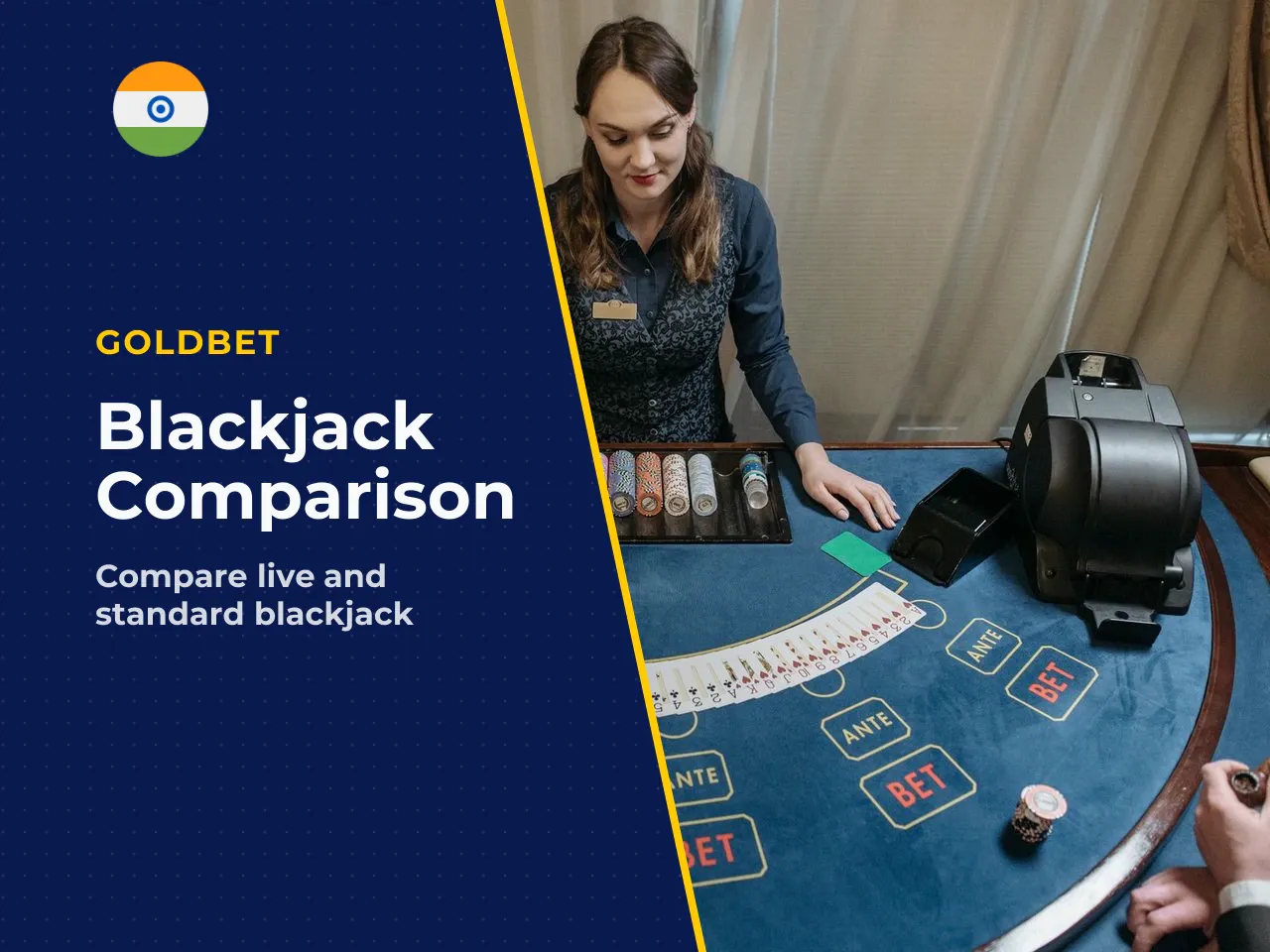
Live Dealer vs Standard Blackjack Game

An important caveat accompanies the popularity of live dealer formats. A large-scale study examining behavioural markers of gambling harm found that participation in live table games, as opposed to simulated (RNG) table games, showed a stronger association with markers of harmful behaviour, contrary to initial hypotheses. Specifically, short event frequencies, higher bet sizes, and engagement in live rather than simulated table games were three configurations that showed larger associations with harmful outcomes.

This does not mean live dealer blackjack is inherently dangerous. But it does underscore the importance of responsible gambling tools. Look for licensed casino platforms that offer deposit limits, session time reminders, self-exclusion options, and reality checks, especially in the live dealer environment where longer sessions and higher average bets are the norm.

For Indian players specifically, checking whether a live casino supports INR deposits, UPI or NetBanking payments, and has a clear KYC process before your first session can prevent headaches later. The excitement of a live table is real. The need for preparation is equally real.

Live Dealer vs Standard Blackjack Game

How to Choose a Blackjack Casino Before You Play

Bonuses, Payouts and Limits That Matter for Blackjack

Choosing a trustworthy online casino requires more than reading a few reviews. Here is a practical checklist.

Licensing. Verify that the casino holds a licence from a recognised regulator. The Malta Gaming Authority (MGA), the UK Gambling Commission (UKGC), or the Gibraltar Regulatory Authority are considered top-tier. Check the licence number manually in the regulator's public registry; do not rely on a logo at the bottom of the site.

Software providers. Look for games from established studios: Evolution (live dealer), Playtech, NetEnt, and Pragmatic Play all undergo regular independent audits. The RTP should be published in the game's information panel.

Payout speed and reputation. Reliable casinos process withdrawals within 24 to 48 hours. Before depositing, search for recent player complaints about delayed payouts on independent forums. Multiple unresolved complaints from the last 6 to 12 months are a red flag.

House edge comparison. Live blackjack with basic strategy offers a house edge under 1%, compared with live baccarat banker bets at 1.06% and European roulette at 2.7%. Average payout percentage analyses indicate that live dealer tables overall return 96 to 97% of wagered funds, while RNG slots return 94 to 98%. Blackjack with favourable rules consistently ranks among the most rewarding games in any online casino.

When evaluating a bonus for blackjack specifically:

  1. Check the contribution rate. If blackjack contributes 10%, multiply the wagering requirement by 10 to find your actual playthrough.
  2. Compare wagering multipliers. A 20x wagering requirement at 10% contribution = 200x effective playthrough on your bonus. A 40x requirement = 400x effective playthrough.
  3. Read the fine print. Some bonuses exclude table games entirely. If blackjack is your primary game, a bonus that excludes it is not worth claiming.

Odds ratios between 1.32 and 4.82 for at-risk behaviours among bonus users indicate that inducements can significantly elevate risk, especially among vulnerable players. Use bonuses as a small supplement, not as a primary reason for choosing a casino.

Look for casinos with low wagering requirements (under 30x) and transparent contribution tables. And if the terms feel confusing after reading them twice, that itself is a warning sign.

Bonuses, Payouts and Limits That Matter

Security, Software and Mobile Play

Security. The site should use 256-bit SSL encryption (indicated by "HTTPS" and a padlock icon in the browser). A transparent privacy policy detailing how personal and financial data is collected, stored, and used is also essential. For Indian players, confirming that the platform supports secure INR transactions and does not share financial data with third parties without consent adds another layer of confidence.

Mobile and technical quality. The majority of online blackjack sessions now happen on mobile devices. When evaluating a casino's mobile experience:

  • Native app vs browser play. Some casinos offer dedicated iOS/Android apps; others rely on responsive HTML5 sites. Both can work well, but test the interface before depositing.
  • Live dealer requirements. For smooth 1080p streaming, a stable connection of at least 5 Mbps is recommended. For 4K quality, aim for 15+ Mbps.
  • Touch interface. Ensure that Hit, Stand, Double, and Split buttons are large enough and well-spaced for touchscreen use. An accidental tap on "Hit" when you meant "Stand" can be costly. It sounds minor until it happens to you.

Support quality. Test the live chat or email support before depositing. Ask a specific question about blackjack wagering contribution or withdrawal timelines. The speed and clarity of the response tells you a lot about how the casino treats its players.

Security, Software and Mobile Play. Security

Disclaimer: The availability of online gambling, bonus terms, and supported payment methods vary by jurisdiction. Always verify whether online blackjack is legal in your region before creating an account. This article does not constitute legal advice. Online gambling is regulated at the national and sometimes state/provincial level. In many jurisdictions, operators must hold a local licence or be approved by a recognised international regulator. If you are in a jurisdiction where online gambling is restricted or prohibited, do not attempt to circumvent geo-blocking. If you are unsure of your local laws, consult a legal professional.

FAQ About Blackjack Online

Is Blackjack Easier to Learn in Demo Than in a Casino?

Yes. Demo mode removes financial pressure and time constraints, letting you focus entirely on memorising card values, hand logic, and strategy chart decisions. In a live dealer casino, a countdown timer (usually 15 to 30 seconds) forces rapid decisions, which can lead beginners to make errors. Starting in demo mode and transitioning to real money once basic strategy feels automatic is the most efficient learning path. There is no shame in spending weeks in demo. The cards will still be there when you are ready.

Are All Blackjack Games the Same?

Not at all. Rule variations have a significant impact on the house edge. Switching from 3:2 to 6:5 payouts on blackjacks increases the house edge by about 1.4 percentage points, and requiring the dealer to hit on soft 17 adds approximately 0.2 to 0.3 percentage points. These figures are documented in blackjack probability studies and basic strategy simulations. Other variables, such as the number of decks, whether doubling after splits is allowed, and surrender availability, also shift the odds. Always check the specific rules of the table before you sit down. Two blackjack games at the same casino can have meaningfully different house edges.

What Is the Best Strategy for Online Blackjack?

Basic strategy, the mathematically optimal decision for every hand and dealer upcard combination, is the single most effective tool for reducing the house edge. It lowers the house advantage to approximately 0.5% in standard games. Advanced techniques like card counting offer additional edge in physical casinos but are largely ineffective in online RNG games where the deck is reshuffled after every hand. For most players, mastering basic strategy is more than enough.

Can You Count Cards in Online Blackjack?

Card counting is technically possible in live dealer games where a physical shoe is used, but it is heavily limited by early shuffle points (typically at 50% shoe penetration) and by the slower pace of online dealing. In RNG games, the deck is virtually reshuffled after every hand, rendering any count meaningless. Card counting is best understood as a theoretical concept rather than a practical online strategy.

Do Online Blackjack Games Use Real Dealers?

Some do. Live dealer blackjack games use real human dealers operating from professional studios. You interact via a video stream and place bets through a digital interface. RNG blackjack, by contrast, is fully automated. There is no human dealer, and outcomes are determined entirely by software algorithms. Both formats follow the same blackjack rules, but the experience feels quite different.

Why Do Casinos Limit Blackjack's Bonus Contribution?

Because blackjack has a very high RTP (up to 99.5% with basic strategy), allowing full bonus contribution would make it possible for skilled players to clear wagering requirements with minimal loss, or even at a profit. By limiting blackjack's contribution to 5 to 10%, casinos ensure that bonuses remain commercially viable from their perspective. This is not hidden information, but it is easy to miss if you do not read the terms carefully.

Is It Safe to Play Blackjack Online in My Country?

Safety depends on two factors: the legality of online gambling in your jurisdiction and the trustworthiness of the specific casino. Verify the casino's licence with the issuing regulator, check for SSL encryption, and search for recent player complaints. If online gambling is not legal in your country, do not play. When in doubt, consult a legal professional. For Indian users, the legal landscape varies by state, so local verification is especially important.

What Is the House Edge in Blackjack?

Under standard six-deck rules (dealer stands on all 17s, blackjack pays 3:2, doubling after splits allowed), the house edge with perfect basic strategy is approximately 0.43%. Without strategy, it climbs to 2 to 4%. This makes blackjack one of the lowest house-edge games in any casino, provided you play correctly. Remember: the house edge is a long-term average, not a guarantee for any single session. Set a budget, stick to it, and treat blackjack as entertainment with a cost, not as a source of income.