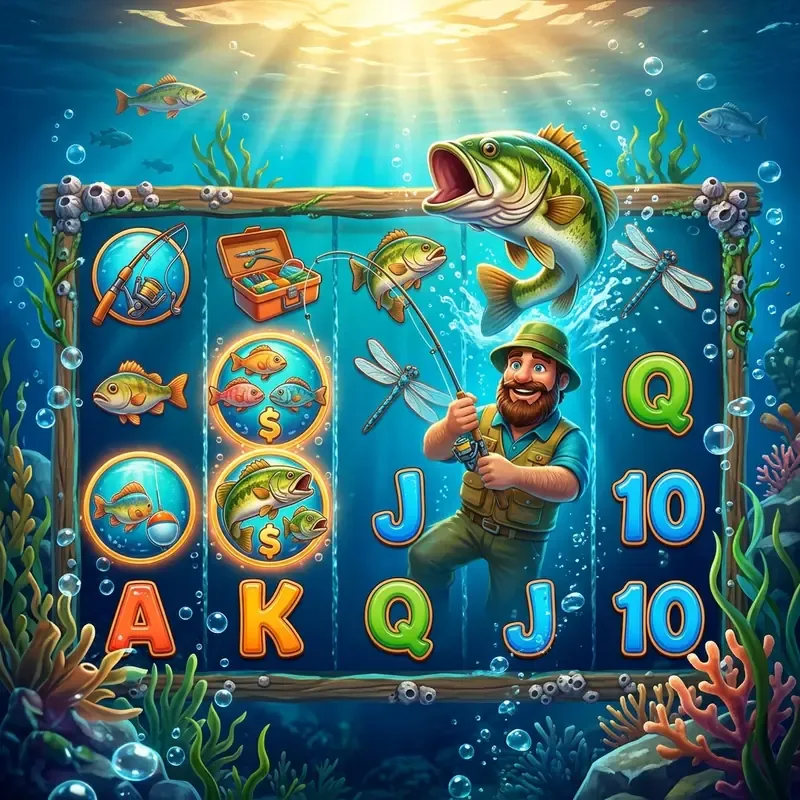
To provide the firsthand experience that separates theory from practice, we loaded the Big Bass Bonanza demo using the same RNG as the real money version and recorded a structured 100-spin session.
Session parameters: Starting balance of 5,000 credits, flat bet of 10 credits per spin (₹10 equivalent), no autoplay.
For the first 47 spins, the base game returned small card-symbol wins, mostly 3-of-a-kind combinations on the 10, J, and Q ranks, interspersed with long dry stretches. Our balance dipped to 4,430 credits before anything notable happened. Patience was tested. On spin 48, three scatters landed, triggering 10 Free Spins. The fisherman appeared on spins 2 and 5 of the round, collecting Money Fish values of 8x and 14x respectively. No retrigger was hit, and the round closed with a 340-credit profit.
From spins 49 to 87, the base game returned to its steady, low-action rhythm. A second scatter near-miss on spin 73 (only two scatters) reminded us why patience matters with high-volatility math.
On spin 88, four scatters appeared, awarding 15 Free Spins. This time, the fisherman surfaced four times across the extended round, hitting the first retrigger threshold and unlocking the 2x multiplier. Combined Money Fish values during that round totalled roughly 85x our bet. The round returned 1,720 credits.
Final result after 100 spins: Starting balance 5,000 > ending balance 5,490. Net outcome: +490 credits (roughly +9.8% over the session).
Key takeaway: The base game is deliberately thin. Nearly all meaningful action, and virtually all of the session's profit, came from two Free Spins rounds that together consumed fewer than 30 of our 100 spins. This pattern aligns perfectly with the high-volatility, bonus-concentrated design Pragmatic Play intended.
Note: This test was conducted on the demo version, which uses the same certified RNG as real money mode. Your results will vary. Slots are games of pure chance.